
The 2026 Professional Compass in the Age of AI
A guided year-end self-audit for how you work, choose, and lead with AI

As December winds down, most of us live in a split screen. On one side is personal reflection- the quiet inventory of how we feel, what changed us, and what we want to carry forward. On the other side is the corporate review- a rigid tally of milestones, metrics, ROI, and shipped features.
We spend nearly one-third of our lives at work, yet rarely audit our professional selves with the same care we bring to our personal lives. We submit reports to managers to prove our value, but rarely submit one to ourselves to understand our evolution.
In 2025, that gap became impossible to ignore. AI adoption in the workplace nearly doubled in two years, jumping from 21% to 40%. Three-quarters of workers using AI report measurable increases in both productivity and work quality. Yet burnout has reached an all-time high: 66% of American workers now report experiencing it, and only 29% feel fulfilled at work.
The tension is clear: technology that promises to liberate us from routine work, colliding with workplaces that drain meaning faster than they create it. The World Economic Forum projects AI will create 170 million new jobs by 2030—but also displace 85 million, demanding rapid reskilling and a fundamental rethink of what professional growth looks like.
I have created a professional self-audit framework that puts agency back where it belongs: with you.
This is not a performance review. It is a clarity exercise.
Think of your career as a portfolio. Some assets are appreciating: judgment, context, relationships, ethical nuance. Others are depreciating: tasks AI can now do faster and cheaper. This exercise isn’t about squeezing more productivity out of your week; it is about meaning-making and deciding what deserves your best attention in the age of AI.
So let’s begin.
Before you move through each pillar, pause and write. Treat this less like an article to skim and more like a working session with yourself. Capture your answers somewhere you can revisit them next December as a record of how your professional operating system is evolving.
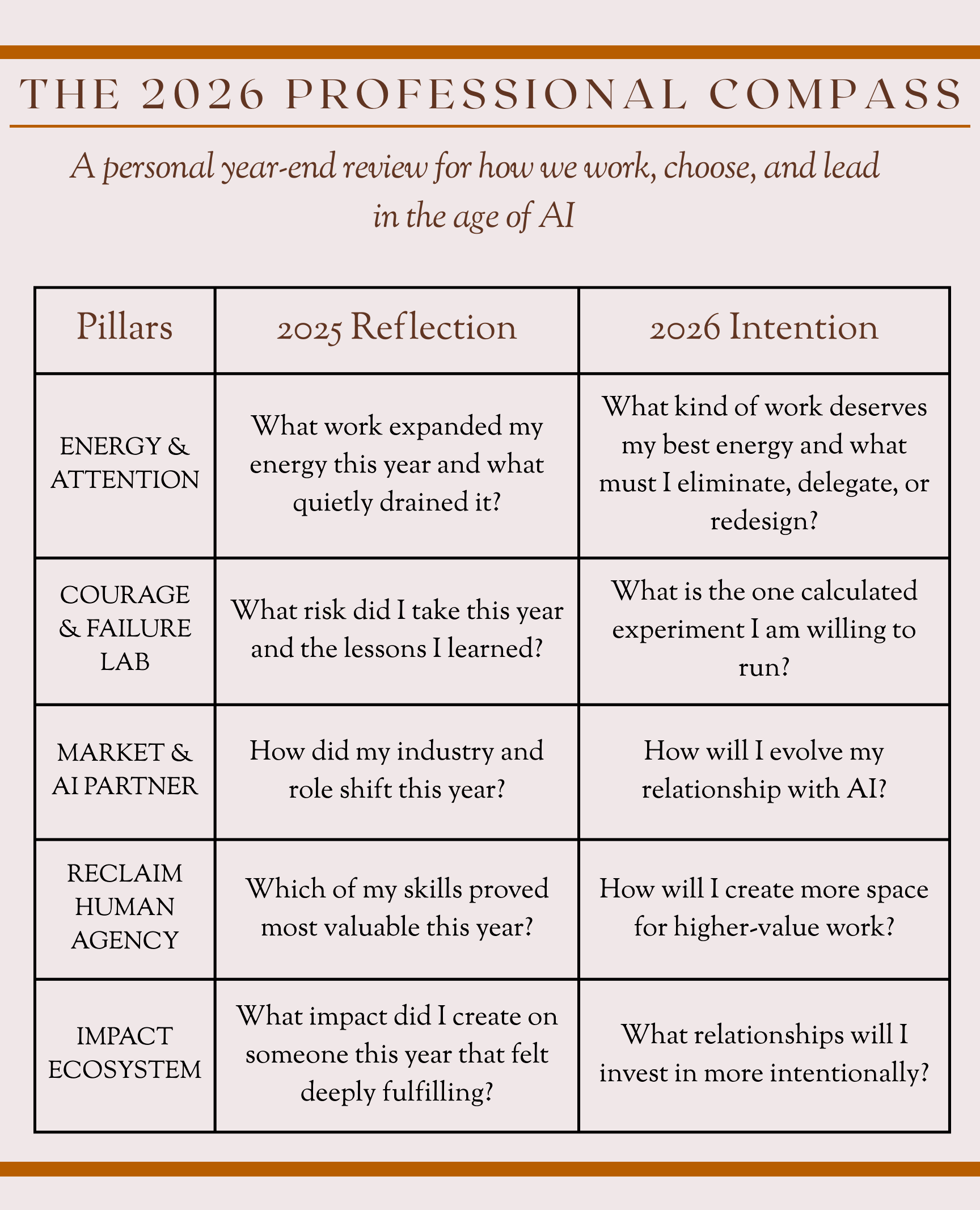
Pillar I: Energy & Attention
The human substrate beneath performance
Not all work costs the same amount of energy. Some work expand you. Some quietly drain you even when you’re “doing well.” Burnout rarely comes from workload alone; it often comes from shelf-work, the tasks that serve a process but no real purpose.
2025 Reflection: What work expanded my energy this year and what quietly drained it despite looking “successful” on paper?
2026 Intention: What kind of work deserves my best energy next year, and what must I eliminate, delegate, or redesign to protect it?
Why it matters: Because energy loss without meaningful progress is one of the fastest paths to burnout, the kind you cannot logically explain, only feel.
Pillar II: Strategic Courage & the Failure Lab
Where growth actually happens
The most meaningful pivots rarely come from certainty. They come from the willingness to be wrong and to learn visibly. In an AI-first economy, playing it safe is often the highest-risk move because the environment shifts faster than your comfort zone.
2025 Reflection: What uncertainty did I step into this year, and what failure or misstep still holds an insight I haven’t fully processed?
2026 Intention: What is one calculated experiment I’m willing to run next year, even if it risks being wrong — to keep learning fast?
Why it matters: It reframes “failure” from a verdict into a data point in your personal R&D lab- raw material for better bets, not evidence you should stop playing.
Pillar III: Market Pulse and the AI Partner
Reality, not hype
The market has moved from ‘using AI’ to ‘orchestrating AI’.
I noticed that when I treated AI like a faster intern, it saved time. When I treated it like a thinking partner, one that could challenge assumptions or surface blind spots- it changed the quality of my decisions.
2025 Reflection: How did my industry and role shift this year, and did I treat AI as a task-runner or as a thinking partner?
2026 Intention: Which of my current skills are depreciating in the age of AI, and how will I evolve my relationship with AI to stay ahead?
Why it matters: It connects macro technological shifts to your daily micro-choices — what you learn, what you delegate, and how you design your own edge.
Pillar IV: Reclaiming Human Agency
Efficiency is not the end goal
Efficiency is a trap if it only buys you more of the same work. The point of automation is not to do more work; it is to do higher work. Speed alone does not create clarity, meaning, or integrity.
There were moments this year where efficiency gave me speed, but not clarity. The real breakthroughs came when I used reclaimed time to think with empathy, synthesize with nuance, and structure narratives for complex decisions, presentations or negotiations.
2025 Reflection: Which of my skills proved most valuable this year precisely because they cannot be automated?
2026 Intention: What 3 tasks/execution work will I fully offload to AI by Q1 to make space for my “higher work” (empathy, ethics, judgement, complex strategy)?
Why it matters: It encourages you to reallocate time toward the skills that appreciate in value — the human capacities that become more scarce and more decisive as automation scales.
Pillar V: The Impact Ecosystem
The only non-commoditized asset
In an automated world, human connection is the last thing that doesn’t scale and that’s exactly why it matters. This year, the moments that stayed with me were rarely about visibility or recognition; they were about one-on-one interventions, helping someone think more clearly or act more boldly.
Your career is not just a sequence of titles. It is a series of trajectories you have helped change through clarity, belief, or access.
2025 Reflection: What impact did I create on someone (mentee, peer, client) this year that cannot be quantified but felt deeply fulfilling?
2026 Intention: Who made a meaningful impact on me, and how can I invest more intentionally in relationships like these?
Why it matters: It surfaces the non-commoditized value of your network and your presence — the depth of impact that compounds long after specific outputs are forgotten.
Bringing the audit together
A professional self-audit is not about perfection; it is about precision. Where your energy goes, what risks you take, how you partner with AI, and who you invest in—these choices compound.
As you enter 2026, treat these 5 pillars less as questions to answer once and more as a compass to return to. Your job title may change. Your tools will certainly change. But how you allocate attention, courage, and care remains yours to design.
May your next year of work feel less like performing for a review cycle and more like owning a portfolio you are proud to call your own.
If you’re doing your own version of this audit, I’d love to know:
What question are you asking yourself as you step into 2026 that isn’t usually part of a performance review?
Feel free to share it in the comments.
Stay curious,
Prabh
Research Notes
This essay draws on recent workforce research from Gallup (AI adoption trends), PwC (Global Workforce Hopes and Fears Survey 2025), Forbes (burnout statistics) and the World Economic Forum (Future of Jobs Report 2025). Links embedded in the essay.